


Every piano makes a sound. A Steinway makes the room that holds it.
The house that built the instrument also built the hall. In 1866, thirteen years after founding the company, William Steinway opened a two-thousand-seat concert venue on East 14th Street in Manhattan. The New York Philharmonic moved in and stayed for twenty-five years. Concertgoers entered through the showroom. They walked past one hundred Steinway pianos to reach the stage where a Steinway piano was already waiting. William Steinway understood something that the rest of the industry spent the next century trying to replicate: the instrument and the room are the same argument. Build one without the other and neither holds.
That conviction did not stop at the hall. The house built a factory in Astoria, Queens, in the 1870s and then built a village around it. Houses for workers. A kindergarten. A lending library. A post office. A volunteer fire department. Parks. A foundry. A sawmill. A streetcar line connecting the village to Manhattan. The street that ran through it still carries the name. The factory still stands on the same property, still producing six pianos a day, still staffed by craftsmen whose tenure is measured in decades. One hundred and seventy-three years. Two factories. Two continents. The same loft on Varick Street where the first instrument was numbered, the same hands on the rim press in Queens where the latest one is bent.
The argument is integration. Steinway built an ecosystem.
Heinrich Engelhard Steinweg was born on February 15, 1797, in Wolfshagen, in the Harz Mountains of the Duchy of Brunswick. He was orphaned in childhood, conscripted into the Prussian army, and fought at the Battle of Waterloo in 1815 as a bugler. His military service gave him access to a cabinetry apprenticeship. By the mid-1820s, he had built his first keyboard instrument in the kitchen of his home in Seesen: a fortepiano, the English-derived predecessor to the modern piano, named for its capacity to play loud and soft.
He built 482 pianos in Germany over the next two decades. In 1839, he exhibited three instruments at a state trade exhibition in Braunschweig and won a gold medal. The work was recognized. The country was not stable. Political unrest from the revolutions of 1848 pushed the family toward emigration, and on June 29, 1850, Heinrich, his wife Juliane, and seven of their nine children arrived in New York. The eldest son, C. F. Theodore, stayed behind in Germany to continue the Steinweg piano business.
The family spent three years working in other manufacturers’ shops, learning the American trade. On March 5, 1853, Heinrich anglicized his name to Henry E. Steinway and founded Steinway & Sons in a loft at the back of 85 Varick Street in lower Manhattan. The first piano bore the number 483, continuing the count from Germany.1 It sold to a New York family for five hundred dollars.


Within two years, the scale had shifted. At the 1855 American Institute Fair, held in the New York Crystal Palace at what is now Bryant Park, Steinway won a gold medal. By the end of the Civil War, the company employed over 350 men, produced nearly 1,800 pianos per year, and occupied an entire block between Park Avenue and 52nd and 53rd Streets, where the Seagram Building stands today. The official language of the factory floor was German. The workforce was almost entirely immigrant.
The patents arrived in sequence. The first was granted in 1857. The overstrung scale, a design in which bass strings cross over the higher ones to permit longer strings and improved tone, appeared in a square piano that same year. The improved cast-iron frame, strong enough to bear string tension without warping, followed. In 1872, C. F. Theodore, who had rejoined the family in New York in the mid-1860s, patented duplex scaling: a system that lengthened the undamped portions of the strings and allowed them to vibrate in sympathy with the main section, producing a fuller, more complex sound. This patent drew directly from Theodore’s friendship with the German physicist Hermann von Helmholtz, who was advancing the science of acoustics at the same time.
One hundred and thirty-nine patents in total. More than any piano manufacturer in history. Nearly half were secured in the first thirty years. The patents mattered. What mattered more was what Steinway built around them: an infrastructure.
“One concert on Saturday night sells pianos on Monday morning.”
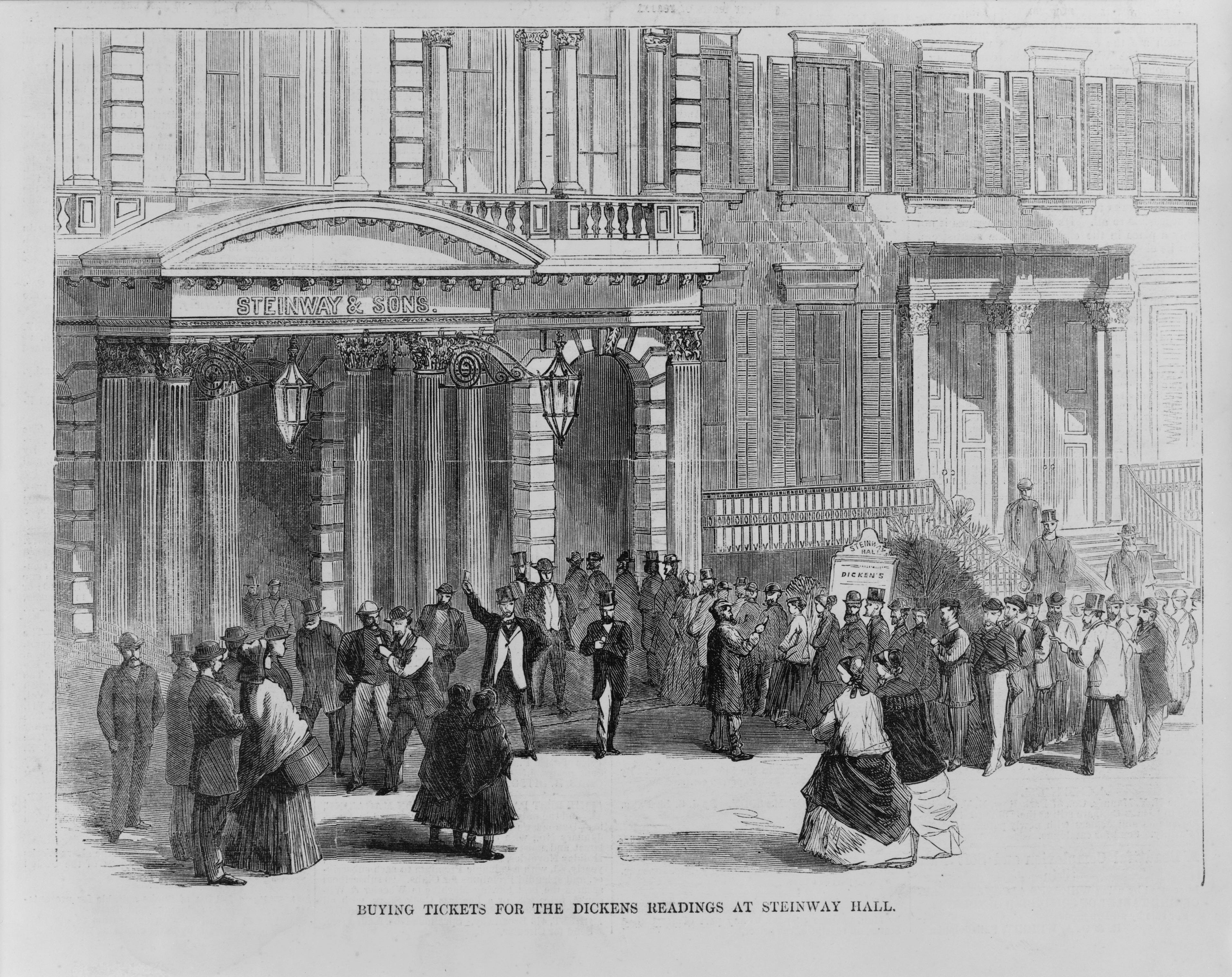
In 1866, William Steinway opened Steinway Hall on East 14th Street.2 The building cost $90,786. The main auditorium seated two thousand and held a stage large enough for a hundred-piece orchestra. The hall was finished in five months, rushed into service after the Academy of Music burned. The New York Philharmonic took up residence and did not leave until Carnegie Hall opened in 1891, twenty-five years later.
William’s logic was commercial and total. Concertgoers entered through the Steinway showrooms. They heard the instruments on stage. They purchased them on the way out. “One concert on Saturday night sells pianos on Monday morning,” William wrote. The strategy worked so completely that competitors were forced to build their own halls: Chickering Hall, Aeolian Hall, each an attempt to replicate what Steinway had created. None lasted.
In 1872, Steinway organized an American concert tour for the Russian pianist Anton Rubinstein. Two hundred and fifteen concerts in 239 days, every one performed on a Steinway concert grand. Rubinstein’s sold-out recital at Steinway Hall drew a standing-room crowd of three thousand. The Steinway Artist program was born from that tour. Two decades later, the Polish pianist Ignacy Jan Paderewski played 107 concerts in 117 days on Steinway instruments, a transcontinental circuit that turned him into the first international celebrity pianist. The instrument traveled with the artist. The artist carried the name.
Charles Dickens read to a capacity audience at Steinway Hall on December 9, 1867. Jenny Lind sang there. Fritz Kreisler made his debut on its stage at the age of thirteen in 1888. The hall was a thesis. The piano, the performer, the audience, and the showroom occupied the same building. The instrument made the music. The music sold the instrument. Integration.
The hall was the beginning. In the early 1870s, William purchased land across the East River in what was then the northern reaches of Long Island City. He built a new factory. Then he built a town.
Steinway Village rose around the factory on four hundred acres of Queens waterfront. Worker housing. A kindergarten, one of the first in the country. A lending library. A post office. Parks. A volunteer fire department. A sawmill. An iron foundry. William built a streetcar line and a ferry service to connect the village to Manhattan. He developed North Beach Amusement Park on adjacent land. He helped capitalize the early ventures of Gottlieb Daimler, the automobile pioneer. He served as head of the New York Subway Commission, planning the transit network that would reshape the city.
The village was eventually absorbed into Long Island City, and the land where the amusement park stood became LaGuardia Airport. But Steinway Street remains. The factory remains. The same property the company has occupied since the 1870s still produces pianos. Six a day. Roughly 1,300 a year from the New York factory alone. Another facility in Hamburg, Germany, opened in 1880 by William and C. F. Theodore to reach the European market and avoid import tariffs, produces approximately 1,200 more. Between the two factories, total annual production holds near 2,500 grand pianos and a few hundred uprights.
The scale is deliberate. Eleven months to build a single grand piano. Twelve thousand individual parts. Over 90 percent of those parts produced in the company’s own facilities. The company maintains its own lumber yards at both factories, aging and drying wood for up to two years before it enters production. Less than half the wood is ever used. More than 70 percent of the walnut stock is discarded. There is no third-party shortcut. There is the wood and the time it demands.
“The soundboard is the soul of the piano.”
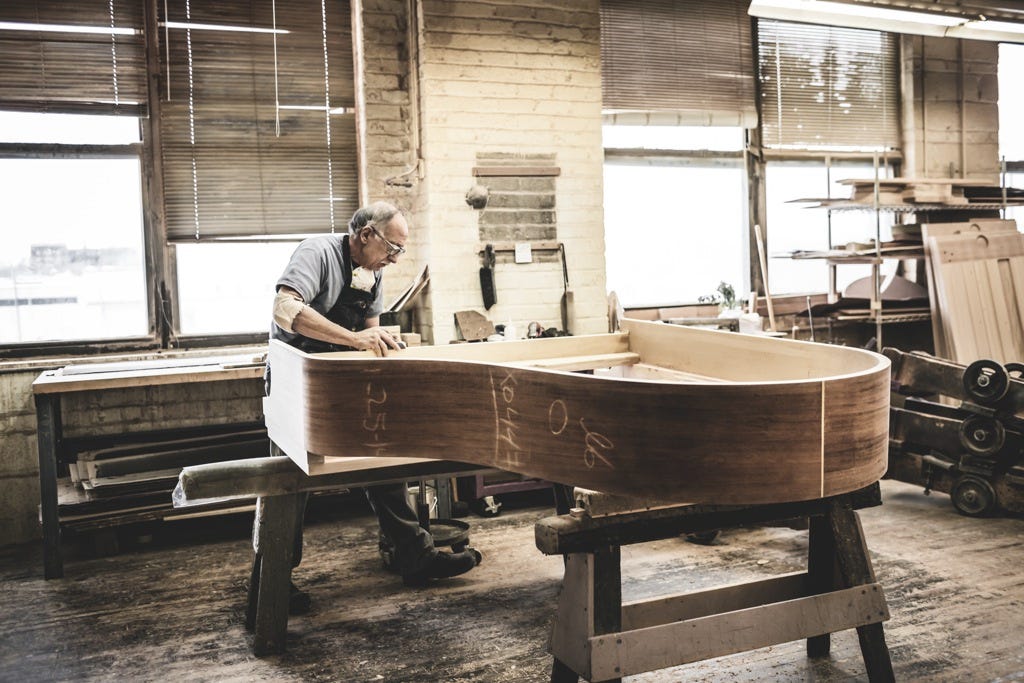
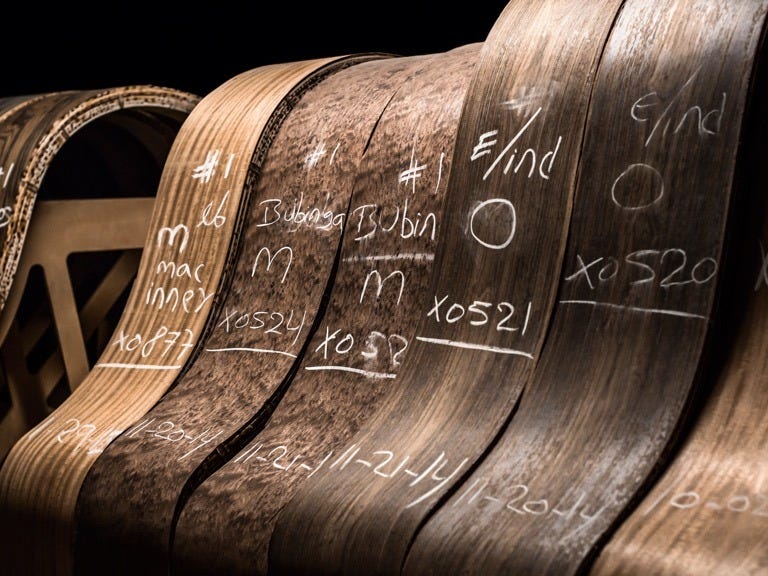
The Steinway grand piano begins from the outside in. The rim comes first: up to twenty layers of hard rock maple, glued and bent in a single operation on a rim press that C. F. Theodore Steinway patented in 1880. Five craftsmen have roughly twenty minutes to bend the wood before the glue sets. Once shaped, the rim rests in a conditioning room for approximately one hundred days.
While the rim cures, other components are produced. The cast-iron plate, weighing several hundred pounds, bears string tension of up to 40,000 pounds. The keys and action mechanism contain thousands of moving parts, each adjusted by hand. The hammers, covered in premium wool felt, are compression-wired to maintain their shape. The strings are high-tensile Swedish steel in the treble, copper-wound Swedish steel in the bass.
At the center is the soundboard. Steinway sources its soundboard spruce exclusively from a single island in Alaska: Sitka spruce, close-grained, quarter-sawn, with annual growth rings measuring eight to twelve per inch. Each tree is at least two hundred years old when harvested. The soundboard follows a design patented in 1936: the Diaphragmatic Soundboard, tapered from nine millimeters at the center to six millimeters at the edges, permitting the board to vibrate as a single unit rather than in sections. Franz Mohr, Steinway’s chief concert technician from 1958 to 1992, called it plainly. “The soundboard is the soul of the piano. It picks up the vibration of the strings, amplifies it, and throws it into the air.”
The soundboard rests inside the hard rock maple rim, and when the sound-producing energy reaches the inner wall, it returns to the body of the board, where it resonates again. The hardness of the maple and the flexibility of the spruce create a feedback loop. The instrument amplifies itself. This is the integration at the level of physics: two woods, two functions, one system.
Every Steinway is tuned five times during production. Twice during this process, a machine in the pounding room strikes all 88 keys simultaneously. The instrument is played in. “The sound and tone of the piano will open up and get richer,” said Mark Dylan, a thirty-three-year veteran and head of tone regulation at the Astoria factory. At the end of the line, a final tone inspector listens. Wally Boot held that post for fifty-one years. He was the last person to touch every piano before it left the factory.


For 119 years, the house was the family. Henry Steinway died in 1871. His sons William and C. F. Theodore carried the company through its period of greatest expansion and innovation. Successive generations held the firm through two world wars, the Great Depression, and the near-total collapse of the American piano market. During World War II, the New York factory built wooden glider parts for the military and produced 2,436 Victory Verticals, olive-drab uprights small enough for four men to lift, designed to be dropped by parachute to soldiers overseas. The Hamburg factory was nearly destroyed by Allied bombing.
In 1972, the family sold. The reasons were familiar: estate taxes, a decade of declining demand driven by Japanese imports, factional disagreements among family members, and the cumulative exhaustion of sustaining a craft enterprise through a century that increasingly favored volume. Henry Z. Steinway, the last family president, completed an exchange of shares with CBS, Inc. Twenty-four offers had been received and declined between 1955 and 1968. The twenty-fifth went through.
CBS was a poor custodian. Bureaucracy replaced the family’s direct oversight. Three presidents in less than a decade. Production fell from over 5,400 pianos in 1976 to under 4,400 by 1982. The corporate parent treated the house as a line item. In 1985, CBS sold Steinway to a group of Boston investors. A decade later, the company was sold again, to Selmer Industries, and in 1996 it went public on the New York Stock Exchange under the ticker symbol LVB. Ludwig van Beethoven.
In September 2013, the hedge fund manager John Paulson acquired Steinway Musical Instruments for $512 million, outbidding the private equity firm Kohlberg & Co. by five dollars per share. Paulson owned three Steinway pianos personally. He told the press he viewed the company as an investment that would increase in value over time and promised to maintain the handcrafted production process. “Over the last 160 years, Steinway has built an unprecedented reputation for excellence,” Paulson said. “We will uphold that tradition with the continued uncompromising pursuit of perfection.”
The tension is the distance between that sentence and the structure that produced it. A hedge fund holds assets. A family holds a standard. The pianos are still built by hand, still finished one at a time, still tuned and tested by craftsmen who have spent decades on the factory floor. But the question that now governs the house is whether integration survives when the person who owns the instrument has no history of building rooms for it.


There is a commercial fact that requires naming. Steinway’s share of the high-end grand piano market exceeds 80 percent. Ninety-seven percent of piano soloists performing with the world’s one hundred leading orchestras play on Steinways, a figure that has never dropped below 95 percent in any surveyed year.3 Over 1,700 active concert pianists bear the title Steinway Artist. None is compensated. Each chose the instrument on its merits and signed an exclusivity commitment of their own will.
The dominance has drawn criticism. Some musicians and writers have argued that the Steinway Artist program, combined with the All-Steinway School designation, which requires institutions to maintain an inventory of at least 90 percent Steinway-brand pianos, creates a closed system that suppresses competition and homogenizes the sound favored by pianists. The competitors are real: Bösendorfer, Fazioli, Bechstein, Yamaha, Shigeru Kawai. Each makes instruments of genuine distinction. The argument against Steinway is that distinction itself is being narrowed.
The second tension is ubiquity. Steinway’s argument was always integration: the piano, the hall, the artist, the room. But integration, at scale, becomes something else. It becomes a standard. And a standard, once established, can begin to crowd out the variety that produced it. The question is whether the house can hold the line between building the room and filling every room.
“The piano is very, very much the same piano that you would've gotten back in the late 1800s.”
In the basement of Steinway Hall, a piano bank holds approximately 250 concert instruments, valued collectively at $12.5 million. When a Steinway Artist has a performance, they descend to the selection room, play several instruments, and choose the one whose voice fits the hall. The piano is tuned, prepared, and delivered to the venue. No rental fee is charged. The artist plays. The audience listens. The piano returns to the bank.
Vladimir Horowitz traveled with his own Steinway for decades. Sergei Rachmaninoff and Horowitz once met by accident in the Steinway Hall basement. Both had keys. They worked through Rachmaninoff’s Third Piano Concerto together, on company instruments, in a room that existed for exactly this purpose.
The room was always part of the instrument. The hall, the village, the factory, the bank. Henry Steinway built a piano in a kitchen in Seesen. His sons built a hall on 14th Street. His grandson built a village in Queens. The street still carries the name. The factory still stands on the same ground. The spruce still comes from the same island. Eleven months. Twelve thousand parts. Six pianos a day.
The count that began at 483 in a loft on Varick Street has not stopped. The room keeps filling.
All images courtesy of Steinway & Sons
Higher Class Editions Venustas Ante Omnia
Steinway & Sons was founded on March 5, 1853. The family name was not anglicized from Steinweg to Steinway until 1864. The first piano bore the serial number 483, continuing the count from the 482 instruments Heinrich had built in Germany. That first piano is now on display at the Städtisches Museum Seesen.
In 1925, the original Steinway Hall on East 14th Street was closed and replaced by a new Steinway Hall at 109-113 West 57th Street, designed by Warren and Wetmore, the same firm responsible for Grand Central Terminal. That building served as Steinway's headquarters and showroom for nearly nine decades before the company relocated to its current Steinway Hall on Sixth Avenue in 2016.
Steinway's symphony survey, conducted following each concert season, has consistently shown that over 97 percent of piano soloists performing with the world's major orchestras choose Steinway instruments. During the 2018-19 season, the survey included data from 794 performances with 100 orchestras worldwide. Of those, 777 soloists performed on Steinways.